Detecting drones by the sound they make
Small drones that fly on fiber-optic cable or on autopilot give off no radio signal, so most detectors miss them. DroSonic listens for their propellers instead, on low-cost sensors that send nothing and need no cloud.
The challenge
The drones that matter most today are the hardest to see. Fiber-optic and autonomous drones have no radio link for RF detectors to find or jam, and small drones flying low are hard for radar to pick out.
What we built
- Small microphone nodes listen for the tone every spinning propeller makes.
- Each node recognizes the sound itself, in real time, without sending audio anywhere.
- The nodes compare when each one heard the drone to work out where it is, and pass the track to the people and systems that respond.
Results
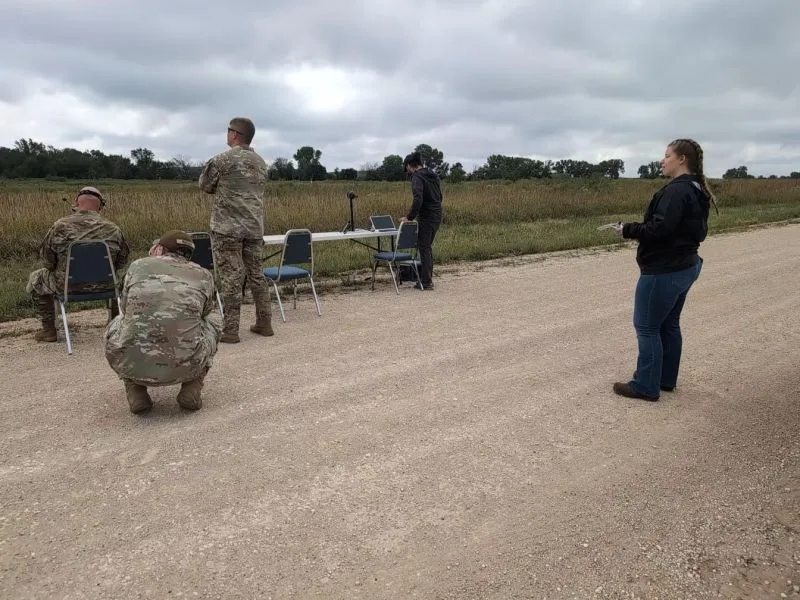
- Tested against live drones at DIRT Days 26.04, a field exercise supported by CMI2 with U.S. Central Command and U.S. Army DEVCOM (September 2026).
- Presented at the NDIA Emerging Technologies for Defense conference (September 2026).
- Selected as an experiment at JIFX 27-1, Naval Postgraduate School (November 2026).
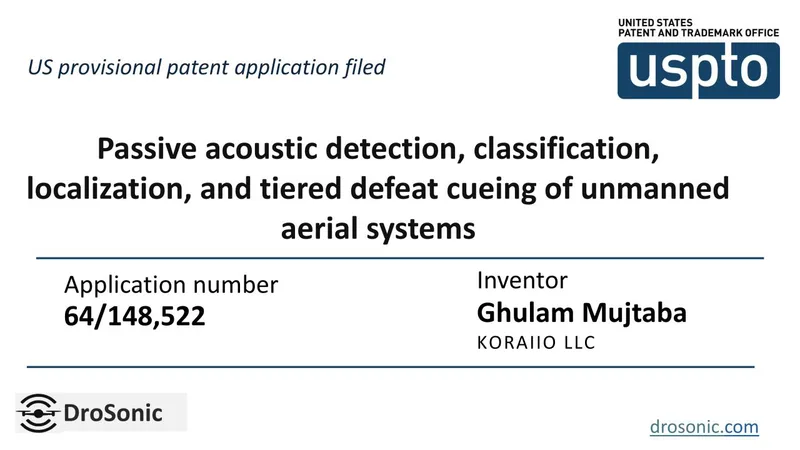
- U.S. provisional patent application 64/148,522 filed.
Where this applies
- Military bases and forward positions
- Airports, power plants and other critical sites
- Borders, perimeters and large public events
Under the hood
- Detection of the blade-pass frequency and its harmonics; compressed neural networks classify on each node.
- Localization by GCC-PHAT time-difference-of-arrival fused across the node network.
- Fully passive (no emissions, no spectrum license); the network degrades gracefully if nodes lose connectivity.
Microphone arraysGCC-PHAT TDOACompressed CNNsNVIDIA edge hardware