Catching online threats to children before they escalate
A team of AI agents that reads messages close to the user, spots grooming and exploitation aimed at minors, and steps in within a tenth of a second, without sending private conversations to the cloud.
The challenge
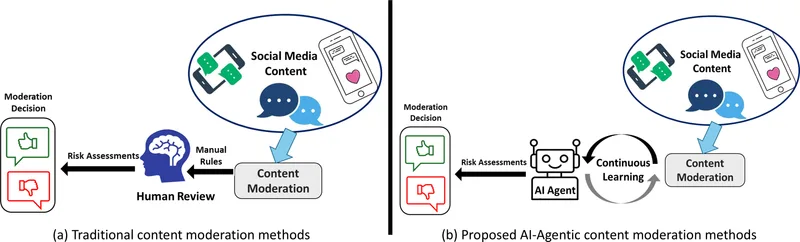
Grooming and bullying tactics change faster than keyword filters and rulebooks can keep up, and human review is slow. Cloud moderation adds delay and means private messages leave the device.
What we built
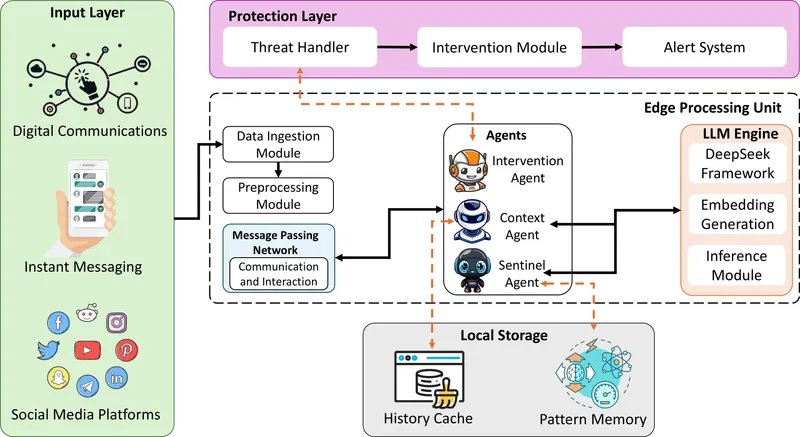
- A watcher agent flags risky messages as they arrive.
- A context agent reads them against the conversation so far, so messages are judged in context, not one at a time.
- An intervention agent decides how to respond, from an intervention to an alert, and the system learns new patterns as it goes.
- Everything runs on a small edge computer with its own memory of past threats.
Results
- Caught threats more accurately than the five other methods tested, 93.4% accuracy against 90.4% for the next best.
- Responded in 98 milliseconds on the edge device, faster than every alternative that could run there.
- Ran on an NVIDIA Jetson AGX Orin at 9.8 watts with a 287 MB model, the lightest of all methods measured.
Where this applies
- Messaging, gaming and social apps with young users
- Trust and safety teams that need on-device or on-premises moderation
- Any setting where conversations can't leave the device
Under the hood
- Sentinel, Context and Intervention agents share an on-device LLM engine (embedding generation and inference), a history cache and a pattern memory.
- Compared with BERT, GPT-3, LLaMA, HateLLM and a Transformer baseline: 92.9% F1; 98 ms edge latency and 10.2 requests per second (HateLLM: 142 ms, 7.0 req/s); 834 MB memory and 67% GPU.
- Paper - Mujtaba, Khowaja and Dev, IEEE Internet of Things Journal, 2025 (with Dublin City University).
Agentic LLMsMulti-agent orchestrationNVIDIA Jetson AGX Orin